

Irvine Unified School District (IUSD) does not split secondary math into algebra and geometry. It uses Integrated Mathematics, with courses named Math I, Math II, and Math III. Which route a student takes, and when AP Calculus becomes reachable, is governed by the district’s math placement regulation (Administrative Regulation 6142.92), which applies identically at all five comprehensive high schools.
This page lays out the official pathway, the criteria behind every placement decision, and the exact thresholds at each transition. Everything here comes from the district’s published policy, revised January 2023 and in effect since 2023-24.
The official pathway chart
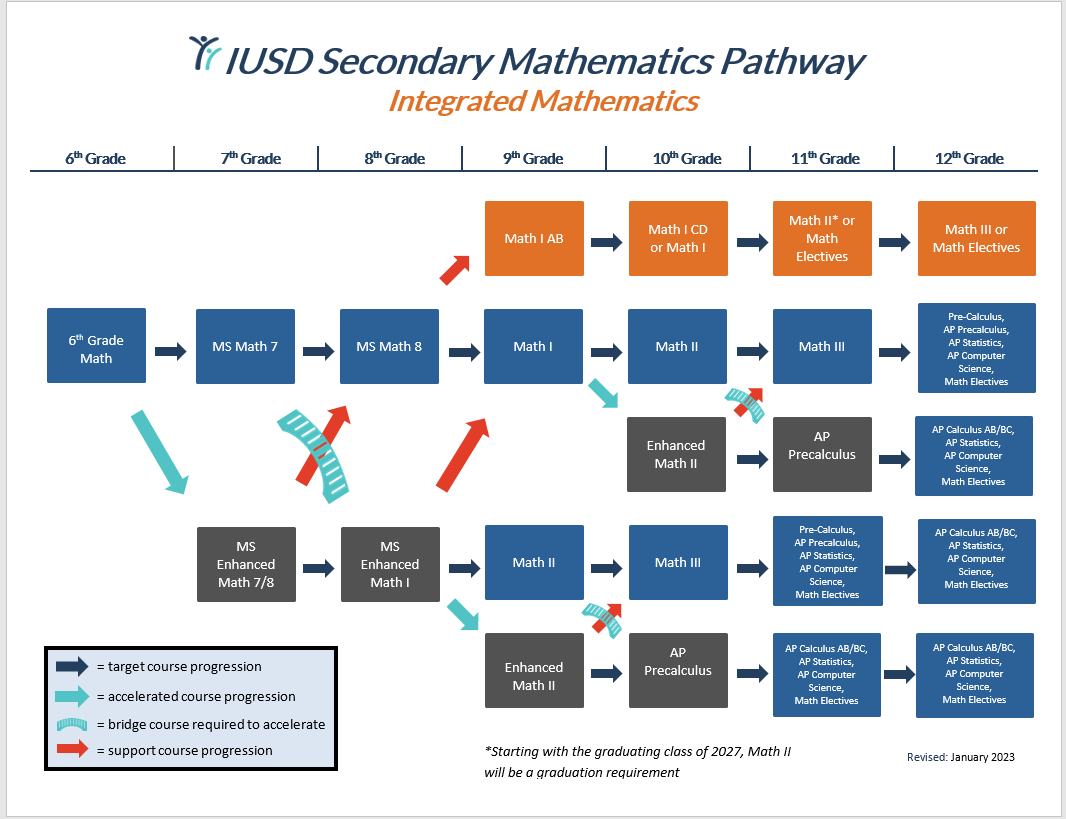
Source: IUSD Secondary Mathematics Pathway, Integrated Mathematics (Figure 1, revised January 2023). Dark blue arrows mark the target progression, teal marks acceleration, hatched teal marks a bridge course required before accelerating, and red marks the support progression. The chart also notes that beginning with the class of 2027, Math II is a graduation requirement.
Three routes
The district sorts every student’s math into three categories. The target course is the grade-level course, and it is the route that satisfies both high school graduation and UC entrance requirements. Acceleration and support are the two departures from it.
| Grade | Target | Accelerated | Support |
|---|---|---|---|
| 6 | 6th Grade Math | 6th Grade Math | — |
| 7 | MS Math 7 | MS Enhanced Math 7/8 | — |
| 8 | MS Math 8 | MS Enhanced Math I | — |
| 9 | Math I | Math II | Math I AB |
| 10 | Math II | Math III or Enhanced Math II | Math I CD or Math I |
| 11 | Math III | AP Precalculus | Math II or electives |
| 12 | AP Precalculus, AP Statistics, AP Computer Science, electives |
AP Calculus AB / BC | Math III or electives |
Two compressed sequences do the heavy lifting. MS Enhanced Math 7/8 and MS Enhanced Math I compact three years of content (Math 7, Math 8, Math I) into two. In high school, Enhanced Math II and AP Precalculus compact three years (Math II, Math III, Precalculus) into two. A student who completes the two-year middle school sequence has finished the state’s target course for grade 9.
On the support route, Math I AB and Math I CD each deliver half of Math I along with prerequisite standards, spreading Math I across two years.
The four measures behind every decision
Placement is never based on a single test. Understanding what each measure asks is the prerequisite to planning for acceleration.
- Final grades in each marking period — trimesters in grades 6 to 8, semesters in high school. Grades are not averaged across marking periods, and minus grades count (A is 90% or above, B is 80 to 89%, C is 70 to 79%, D is 60 to 69%, F is 59% or below).
- End of Course Assessment (EOC) — built from the state content and process standards for that course, covering conceptual understanding, procedural skill, and the application of both in problem solving.
- Appraisal of the Standards for Mathematical Practice (SMPs) and work habits — the eight state-adopted practice standards, judged by the classroom teacher.
- Basic Skills Exam — for students entering grade 7 only. It tests addition, subtraction, multiplication, and division with whole numbers, fractions, and percentages, drawn from grade 4 to 6 California standards.
Thresholds at each transition
The tables below follow Appendix A of the district policy, organized by the course a student is currently taking.
Grade 6 students
| Measure | Target: Math 7 | Accelerated: Enhanced Math 7/8 (3 of 4) |
|---|---|---|
| Grade | Below A- | A- or higher each trimester |
| End of Course Assessment | Below 85% | 85% or above |
| Basic Skills Exam | Below 90% | 90% or above |
| SMP appraisal | No | Yes |
Students in Math 7
| Measure | Target: Math 8 | Accelerated: MS Summer Bridge (2 of 3) |
|---|---|---|
| Grade | All students are placed in Math 8 unless they meet the acceleration criteria | A- or higher each trimester |
| End of Course Assessment | — | 85% or above |
| SMP appraisal | — | Yes |
MS Bridge Course is offered through IUSD middle school summer school.
Students in Enhanced Math 7/8
| Measure | Target: Math 8 | Accelerated: Enhanced Math I (2 of 3) |
|---|---|---|
| Grade | Student does not meet criteria to continue on the accelerated pathway | B- or higher |
| End of Course Assessment | — | 85% or above |
| SMP appraisal | — | Yes |
Students completing MS Summer Bridge enter Enhanced Math I under the same criteria.
Students in Math 8
| Measure | Target: Math I | Support: Math I AB (all criteria) |
|---|---|---|
| Grade | All students are placed in Math I unless all three criteria are met | Below C- each trimester |
| End of Course Assessment | — | Below 70% |
| SMP appraisal | — | Compelling evidence required, per the Math I ABCD placement appendix |
Students in MS Enhanced Math I
| Measure | Off the accelerated path | Target: Math II (2 of 3) | Accelerated: Enhanced Math II (2 of 3) |
|---|---|---|---|
| Grade | Criteria not met | C- or higher | A- or higher each trimester |
| End of Course Assessment | — | 70% or above | 85% or above |
| SMP appraisal | — | Habits necessary for Math II | Habits necessary for Enhanced Math II |
Students in Math I
| Measure | Repeat Math I | Target: Math II | Accelerated: Enhanced Math II (2 of 3) |
|---|---|---|---|
| Grade | Below C- | C- or higher | A- or higher |
| End of Course Assessment | Below 70% | 70% or above | 85% or above |
| Teacher appraisal | Lacks habits for Math II | Habits necessary for Math II | Habits necessary for Enhanced Math II |
Students in Math II
| Measure | Repeat Math II | Target: Math III | Accelerated: HS Summer Bridge (2 of 3) |
|---|---|---|---|
| Grade | Below C- | C- or higher | A- or higher |
| End of Course Assessment | Below 70% | 70% or above | 85% or above |
| Teacher appraisal | Lacks habits for Math III | Habits necessary for Math III | Yes |
Students in Enhanced Math II
| Measure | Off the accelerated path: Math III | Accelerated: AP Precalculus (2 of 3) |
|---|---|---|
| Grade | Criteria not met | B- or higher each trimester |
| End of Course Assessment | — | 85% or above |
| SMP appraisal | — | Habits necessary for AP Precalculus |
The support route
| Current course | Placement | Grade | End of Course Assessment |
|---|---|---|---|
| Math I AB | Math I | C- or higher | 70% or above |
| Math I AB | Math I CD | D- or higher | 60% or above |
| Math I AB | Math I AB again | Below D- | Below 60% |
| Math I CD | Math II | C- or higher | 70% or above |
| Math I CD | Math I CD again | Below C- | Below 70% |
The two bridge windows
The hatched teal arrows on the chart mean a bridge course is required before accelerating. There are exactly two.
- MS Summer Bridge — for grade 7 students in Math 7 who meet the criteria, taken in summer school, leading to Enhanced Math I in grade 8.
- HS Summer Bridge — for grade 10 students in Math II who meet the criteria, leading to AP Precalculus in grade 11.
For most students the second window is the only chance to rejoin the accelerated track during high school. The bridge course carries its own passing bar, and the five high schools differ in how they administer enrollment; see the math page in each school’s IUSD high school guide (available in Chinese only).
Checkpoints and appeals
One-month checkpoint. Every ninth grader’s placement is reviewed within the first month of school, using external assessment data, standardized test scores where available, and progress in the course. Students showing substantial mastery of the current course may choose to take the End of Course Assessment to verify it. Students in Math I AB have an additional checkpoint in the first week: those who demonstrate mastery of prerequisite standards may be moved to Math I.
Parent recourse. Students, parents, or teachers may appeal a final placement with the site administrator or designee, within the window posted on the IUSD website. Relevant evidence includes grade history, enrichment or supplemental coursework, and standardized test scores. An appeal ends in one of three ways: approval with progress monitoring in the accelerated course, approval to gather additional evidence before the final decision, or denial.
Annual review. Aggregate placement data is analyzed and presented to the IUSD School Board each year, to confirm there is no disproportionate impact by race, ethnicity, gender, or socioeconomic background.
Why the district is cautious about early acceleration
The policy quotes the Mathematics Framework for California Public Schools directly: decisions to accelerate students into higher mathematics before ninth grade must rest on solid evidence of conceptual understanding, procedural skill, fluency, and the ability to apply mathematics, and such decisions “should not be rushed,” because premature accelerated placement can carry negative consequences.
That is why acceleration starts in grade 7 rather than in elementary school, and why every decision point requires grades, an exam, and a teacher appraisal to agree. For families, the practical meaning is that acceleration is not won on a single test. It is the accumulated result of steady work across every marking period of the preceding year.
EDUBUS courses by decision point
| District decision point | When to prepare | Course |
|---|---|---|
| Entering Enhanced Math 7/8 in grade 7 | Grade 6 | Grade 6 Math Acceleration |
| Enhanced Math 7/8 and Enhanced Math I | Grades 7 to 8 | Enhanced Math 7/8, Enhanced Math I |
| Enhanced Math II in grades 9 to 10 | First two years of high school | Enhanced Math II |
| AP Precalculus and AP Calculus | Grades 10 to 12 | AP Precalculus, AP Calculus AB, BC |
| Summer bridging and problem solving | Summer | Singapore Math and Math Bridge |
The full course map is in the math acceleration overview; school-by-school differences in weighting, AP entry grades, and bridge course administration are covered in the IUSD high school guides (available in Chinese only).
Sources
Compiled from the Irvine Unified School District page “MATHEMATICS INSTRUCTION - Administrative Regulation 6142.92 · IUSD Secondary Math Placement,” revised January 2023, including the full placement tables in Appendix A: https://iusd.org/about/board-education/board-policies/mathematics-instruction-0
District policy changes. Confirm placement and course selection against the notices and course catalog your school publishes for the current year. Last checked: September 21, 2026.
How to start
Begin with a placement assessment. We use the result to set the level and confirm the year’s plan with you. For the timetable, tuition, and bundle offers, request the 2026-27 program guide through the form below or by WeChat.
Want to talk to a course advisor now?
Contact a course advisorFrequently Asked Questions
When does math acceleration start in Irvine schools?
Seventh grade. District policy states that acceleration happens through content compaction beginning in grade 7, and that elementary students are not accelerated; those needing enrichment go deeper into grade-level content instead. Sixth grade is therefore the one full year a family has to prepare for an accelerated placement.
What are the multiple measures used for placement?
Four: final grades in each marking period (trimesters in grades 6 to 8, semesters in high school, minus grades included, never averaged across marking periods); the End of Course Assessment for the course; an appraisal of the eight Standards for Mathematical Practice and work habits; and, for students entering grade 7 only, the Basic Skills Exam on whole-number, fraction, and percentage operations from grades 4 to 6.
If a student misses acceleration in grade 7, is there another chance?
There are two bridge windows. MS Summer Bridge follows grade 7 Math 7 and can lead to Enhanced Math I in grade 8. HS Summer Bridge follows grade 10 Math II and can lead to AP Precalculus in grade 11. Outside these two, the district does not accept self-study acceleration or outside coursework as a substitute. School-by-school administration is covered in the IUSD guides for each Irvine high school.
Can Irvine parents appeal a placement decision?
Yes. Students, parents, or teachers may appeal to the site administrator within the window posted on the IUSD website, submitting grade history, enrichment or supplemental coursework, and standardized test scores. An appeal ends in approval with progress monitoring, a request for additional evidence, or denial.
Do Irvine students get a placement review after school starts?
Yes. Every ninth grader is reviewed within the first month using external assessment data and course progress; students showing substantial mastery may take the End of Course Assessment to verify it. Students in Math I AB are reviewed in the first week, and those who demonstrate mastery of prerequisite standards may be moved to Math I.
How does EDUBUS relate to the IUSD pathway?
EDUBUS follows the Irvine Unified School District (IUSD) syllabus and materials, aiming to help students meet the thresholds above at each decision point; it does not change the district's placement rules. The courses mapped to each point are in the last section of this page and in the math acceleration overview.