

In short: Harvard University in Cambridge, Massachusetts, founded in 1636, enrolls 7,103 undergraduates. The Class of 2029 admit rate was about 4.2%, the SAT or ACT is required, and families earning under $100,000 pay nothing.
- Location
- University Hall, Cambridge, MA 02138
- Founded
- 1636
- Acceptance Rate
- About 4.2% (Class of 2029: 47,893 applied, 2,003 admitted)
- Official Website
- www.harvard.edu
Application timelineper school website
- REA applicants complete the SAT or ACT (November dates accepted)Deadline
- Restrictive Early Action application and financial aid materialsDeadline
- REA decisions (admit, defer, or deny)
- Regular Decision applicationDeadline
- RD financial aid materialsDeadline
- Midyear Report submitted
- RD decisions
- Admitted students replyDeadline
Overview
Harvard University sits in Cambridge, Massachusetts. Founded in 1636, it is the oldest institution of higher education in the United States. Harvard College, the undergraduate school, enrolls 7,103 students with a 7:1 student-to-faculty ratio and a 98% graduation rate. Of the 1,675 first-year students in the Class of 2029, 16% are international and 14% come from the Pacific states, including California.
Two kinds of families tend to fit. In the first, the student has built a clear academic direction by grades 9 to 11, and course depth and activities reinforce each other. In the second, family income is modest but the student’s academic record is exceptional, because Harvard’s aid policy brings the cost down sharply. For Irvine families, the first question is how a Harvard application fits alongside the University of California; the last section of this page lays that out by grade.
Admissions data
- Middle Atlantic21%
- New England18%
- South16%
- International16%
- Pacific14%
- Midwest10%
- Mountain3%
- Central2%
Pacific includes California.
- Social sciences35%
- Natural sciences27%
- Engineering25%
- Humanities12%
- Undecided1%
Among enrolling students, 45% attend tuition-free, 26% attend free, and 21% are estimated to be Pell-eligible.
How to apply
Restrictive Early Action
REA- Deadline
- November 1
- Decisions
- Mid-December
- Outcomes are admit, defer to the regular round, or deny; an admit is not binding
- No early application to any other private college, and no binding early program at a public university
- Non-binding early applications to public universities, military academies, and institutions outside the US are allowed; the UC application is unaffected
- Finish the SAT or ACT by the end of October; November dates are accepted
Regular Decision
RD- Deadline
- January 1
- Decisions
- End of March
- Admitted students reply in early May
- Financial aid materials due February 1
- December SAT or February ACT scores are accepted
- Midyear Report submitted in mid-February
Harvard accepts the Common Application and also QuestBridge. The application fee is $95, with waivers for families facing hardship. Materials include the personal essay, five short-answer questions of 150 words each, a school report and transcript from the counselor, recommendations from two teachers in different academic subjects, and midyear and final school reports.
Testing is required. Harvard’s own wording is that it “requires the SAT or ACT,” and TOEFL or IELTS cannot substitute. Only where testing access is genuinely limited does Harvard accept AP, IB, A-Level, or national leaving exam results instead. Scores may be self-reported when applying; admitted students must send official scores. International applicants are not required to take an English proficiency exam but may submit one.
Interviews are conducted by alumni. Harvard arranges them where it can but cannot interview every applicant, and the absence of an interview does not count against a candidate. Admission is need-blind for international students as well as US citizens, meaning an aid application never affects the decision, and Harvard states there are no quotas by citizenship or high school.
Cost and financial aid
- Tuition$62,226
- Fees$6,216
- Housing$14,250
- Food$8,942
What a family actually pays, by income
- Under $100,000$0Parent contribution is zero
- $100,000 to $200,000Tuition $0Aid covers at least full tuition
- Above $200,000Assessed case by case
Aid is need-based only; there are no merit awards. Harvard reports that 25% of its families pay nothing, that the average parent contribution across all families is $13,000, and that 100% of demonstrated need is met. International students are eligible for exactly the same aid as US students, and aid packages for international students include a travel allowance.
Schools and fields of study
Harvard University consists of the undergraduate Harvard College, 12 graduate and professional schools, and the Radcliffe Institute for Advanced Study. The business, law, and medical schools that parents ask about admit graduate students only; an undergraduate application is to Harvard College. There is no admission by school at the undergraduate level: every first-year student enters Harvard College and declares a field in the fall of sophomore year. Harvard calls a major a concentration; there are 50 of them, plus 49 secondary fields (the equivalent of a minor), across more than 3,700 courses.
8fieldsEngineering and applied sciencesShow all
- Applied Math
- Computer Science
- Electrical Engineering (AB/SB)
- Mechanical Engineering (SB)
- Biomedical Engineering
- Environmental Science and Engineering
- Engineering Sciences (AB/SB)
- Energy, Climate, and the Environment
13fieldsNatural sciences and mathematicsShow all
- Mathematics
- Statistics
- Physics
- Chemistry
- Chemistry and Physics
- Astrophysics
- Earth and Planetary Sciences
- Molecular and Cellular Biology
- Integrative Biology
- Chemical and Physical Biology
- Human Developmental and Regenerative Biology
- Human Evolutionary Biology
- Neuroscience
9fieldsSocial sciencesShow all
- Economics
- Government
- Psychology
- Sociology
- Social Studies
- Anthropology
- Environmental Science and Public Policy
- Linguistics
- Studies of Women, Gender, and Sexuality
20fieldsHumanities and artsShow all
- English
- History
- History and Literature
- History and Science
- Philosophy
- Classics
- Comparative Literature
- Art, Film, and Visual Studies
- History of Art and Architecture
- Music
- Theater, Dance & Media
- Comparative Study of Religion
- Folklore and Mythology
- East Asian Studies
- South Asian Studies
- Near Eastern Languages and Civilizations
- African and African American Studies
- Germanic Languages and Literature
- Romance Languages and Literature
- Slavic Literatures and Cultures
Roughly a third of a student’s courses go to College-wide requirements: one course in each of four General Education categories (Aesthetics and Culture; Ethics and Civics; Histories, Societies, Individuals; Science and Technology in Society), one in each of three divisions (Arts and Humanities; Social Sciences; Science, Engineering, and Applied Sciences), plus quantitative reasoning, expository writing, and a language. Double, joint, and special concentrations are also possible.
Engineering concentrations are run by the School of Engineering and Applied Sciences. Most offer both an AB and an SB track, and Applied Math, Computer Science, and Environmental Science and Engineering add a combined AB/SM option. Among the Class of 2029, 25% intend engineering and 27% natural sciences; students on those paths from Irvine high schools have usually reached AP Calculus BC and AP Physics C before applying. Musicians can apply to dual-degree programs with the New England Conservatory or Berklee College of Music, and undergraduates may study abroad at a foreign university for up to a full year.
Campus life
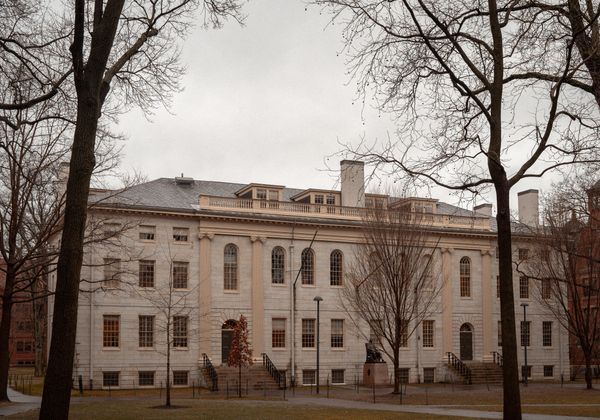


All first-year students live in dorms beside Harvard Yard, grouped into four Yards (Crimson, Elm, Ivy, and Oak); rooms range from doubles to larger suites, with very few singles. On Housing Day in the spring of first year, each student learns which of the 12 Houses they will join from sophomore year; each House holds 350 to 500 students and anchors housing, dining, and advising for the next three years.
A timeline for Irvine families
The five Irvine Unified high schools differ in when AP courses open, how weighting works, and how the math sequence accelerates, and those four years of scheduling shape the depth of an application. School-by-school rules are in the IUSD high school guides.
- Grade 9Set the path, protect grades
- Settle the math and science sequence
- Protect core grades
- Choose one or two activities that can run four years
- Grade 10First AP courses
- Take the first AP courses the school allows
- Turn activities into visible output
- Consider an academic summer program or research
- Grade 11Finish testing
- SAT or ACT: first sitting in spring, second before summer ends
- Dates on the test calendar; prep on the SAT page
- Choose the two recommending teachers and stay in touch
- Fall of grade 12Decide on REA
- REA: application and aid materials by November 1
- File the UC application in the same window
- Otherwise Regular Decision by January 1
Dates and registration deadlines are on the 2026-27 test calendar, and preparation options are on the SAT page.
How EDUBUS helps
EDUBUS college planning runs year by year from grade 9: a four-year course plan built around the rules of each Irvine high school, a testing schedule, a clear activities direction, and in grade 12 a counselor review of every application component and short answer. Preparing the CSS Profile and FAFSA for financial aid is part of the service. To see where a student stands relative to schools like Harvard, start with a free assessment.
Frequently Asked Questions
Do students at Irvine public high schools still need the SAT or ACT for Harvard?
Yes. Harvard requires the SAT or ACT, and English proficiency tests cannot substitute. REA applicants should finish testing by the end of October (November dates are accepted); Regular Decision applicants may use the December SAT or February ACT. See the test calendar for 2026-27 dates.
Can I apply Restrictive Early Action to Harvard and still apply to the University of California?
Yes. REA only bars early applications to other private colleges and binding early applications to public universities. The UC system has no early round, so an Irvine family can submit Harvard REA on November 1 and the UC application in the same season.
At what family income is Harvard tuition-free?
Under Harvard's 2026-27 policy, families earning under $100,000 have a parent contribution of zero, and families between $100,000 and $200,000 receive aid covering at least full tuition. Aid is need-based only, and international students receive the same aid as US students.
Irvine parents ask: is a Harvard interview required?
No. Harvard tries to arrange alumni interviews but cannot interview every applicant, and not having one does not hurt a candidacy. Alumni interviewers are active in the Irvine area and usually reach out after the application is submitted.
What was the admit rate for the Class of 2029?
About 4.2%. Harvard received 47,893 applications and admitted 2,003 students; 1,675 enrolled, 16% of them international and 14% from the Pacific states, including California.
When should an Irvine student start preparing for a Harvard application?
EDUBUS recommends starting in grade 9. Harvard reads four years of course depth and consistency of direction, and the five Irvine Unified high schools differ in when AP courses open and how weighting works, so course selection needs a plan, testing should be done in grade 11, and the REA decision comes in the fall of grade 12.
Sources
Pages checked (14)
- college.harvard.edu/admissions/apply/application-timeline
- college.harvard.edu/admissions/apply/application-requirements
- college.harvard.edu/admissions/apply/first-year-applicants
- college.harvard.edu/admissions/apply/international-applicants
- college.harvard.edu/admissions/admissions-statistics
- college.harvard.edu/financial-aid/how-aid-works
- college.harvard.edu/about
- www.harvard.edu/schools/
- college.harvard.edu/academics/liberal-arts-sciences
- college.harvard.edu/academics/liberal-arts-sciences/concentrations
- advising.college.harvard.edu/academic-planning-for-students/concentrations-and-s
- seas.harvard.edu/academics/undergraduate
- college.harvard.edu/student-life/residential-life
- www.usnews.com/best-colleges/harvard-university-2155